
The Unsettling Pattern in Shakespearean Plays
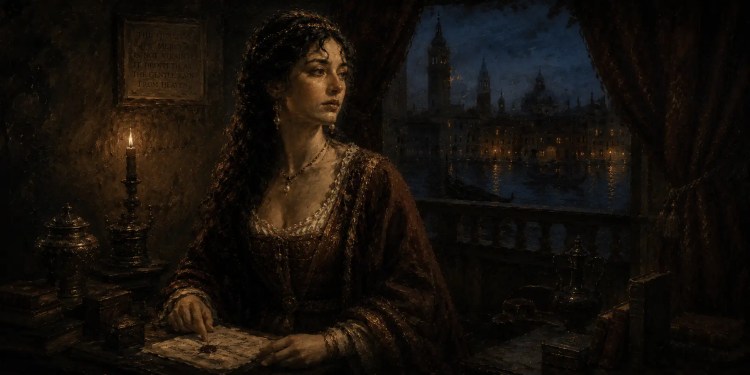
As a literature student, you come across Shakespeare almost like it’s coming back to your roots. You become familiar to him, not because he is compulsorily there in your syllabus, but because he is foundational. His plays act as an evergreen blueprint of human nature. You keep revisiting them, until you notice the underlying patterns that mould these narratives. And then, Shakespeare is never the same again.
My Professor at college recently made me come across one such pattern: Shakespeare’s Motherless Daughters. Young female figures in his plays are often shaped without the presence of a biological mother; they are either dead, or completely unmentioned. And this pattern is not at all accidental, it is essential in a way that the structures of these characters depend on it.
Now this leads us into having a look at Shakespeare’s own life, and the dynamics that might have shaped this pattern. He grew up in a stable household with his parents, John Shakespeare and Mary Arden. As an adult, he became the father of two daughters: Susana Shakespeare and Judith Shakespeare. This suggests that writing about daughters was hence not an abstract idea for him, it was a personal experience. Though there is no direct evidence that his wife, Anne Hathway, was an absent partner or mother, their age gap and his long periods in London, away from his family in Stratford, do suggest a sense of domestic distance. And this might have subtly structured his portrayal of family dynamics as it is known to us today.
Whether consciously or not, Shakespeare keeps returning to the figure of the daughter time and again, placing her in a world where she must mould herself without any motherly support, to survive successfully. The lives of these daughters are mostly centered around their dominating father figures, or a male authority in general, with barely any motherly frame to counterbalance it. They are driven by intense and absolute emotions which are often centered around a single figure, leading to their heightened loyalty.
Consider the case of Desdemona, her choice of marrying Othello feels too abrupt, since there is no maternal presence to guide her through the conflict with her father. We come across a similar setting for Ophelia, who is administered by her father Polonius and influenced by her brother Laertes, surviving within a male-driven world. Her running into madness feels less like a sudden incident and more like a cumulative effect which is built upon throughout the length of the play.
And as you read further into it, you realise that these daughters are not always abandoned. Shakespeare does provide them with a partial space of comfort sometimes, in the form of a friend, a maid or maybe even a nurse. They act as temporary solutions. They do not claim anything, but represent the fragments of a mother; they follow their leads, entertain them and often comfort them, without any interference in the fate of the play.
One such example appears with Juliet, where her relationship with her Nurse functions like an unsaid compensation. The Nurse loves her affectionately, provides guidance at times and even facilitates her secret marriage, but fails brutally at the decisive moment, ending up asking Juliet to marry Paris instead. Her breakdown reveals the true limitations of these substitute figures: they can support these daughters, but cannot replace a mother’s authority.
What emerges now is not just a pattern of recurring absence, but also a trail of incomplete substitutions. Shakespeare’s daughters are rarely left alone, but they are not sufficiently supported either. The presence of these secondary female figures further highlights the absence, rather than resolving it. The daughters are shaped by what they lack as much as by what they possess.
And yet, within this pattern exists a character who does not simply endure this structure, but seems to command it with remarkable control. Next, we will turn to Portia, a character who doesn’t just fit into this pattern, but subtly reshapes it.

Written By – Prerna Bhalothia

