
Ananya and Diksha were the sun that gradually rose above the horizon, slowly turning the black of the night into grey, chasing the grey until the sky turned into a soothing and lively blue before dazzling the whole world with its bright sunny light. Initially, quiet in the class, I wondered in that hybrid mode, if anyone was really paying attention while I was busy exploring filial relationships, the wrath of the wrath, Cordelia’s devotion contrasted to Edmund’s depraved villainy. But then, during discussions, came these two pensive voices with pertinent questions, exploring thought-provoking dimensions that made my heart flutter with joy. Elated, I had to read more and work harder, now that it was proved beyond a doubt that people on the other side of the screen were not only listening intently but mulling and deliberating over it. That was the beginning of a life-long teacher-student relationship that is rooted in the common love for literature, art and discussion of both.
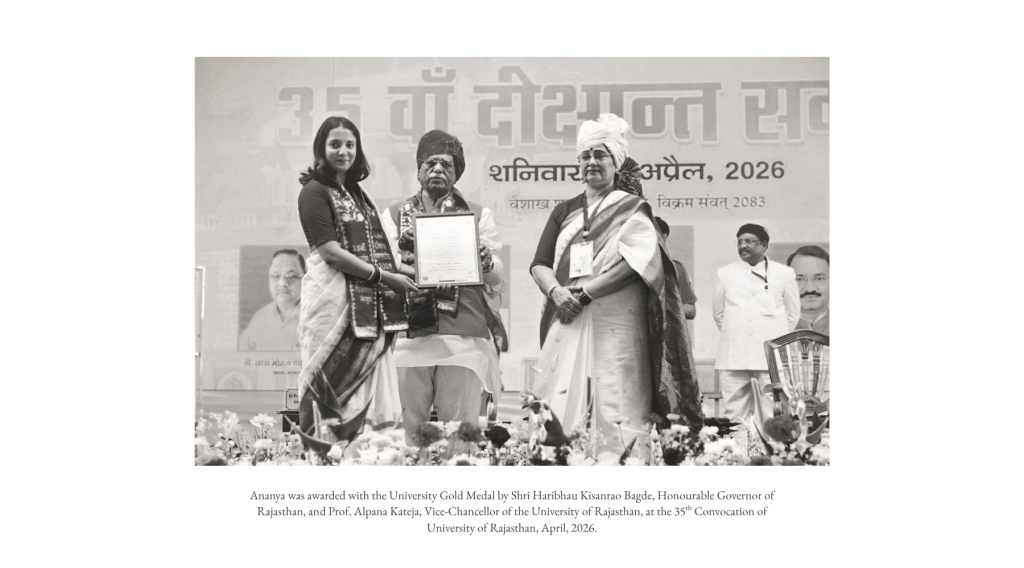
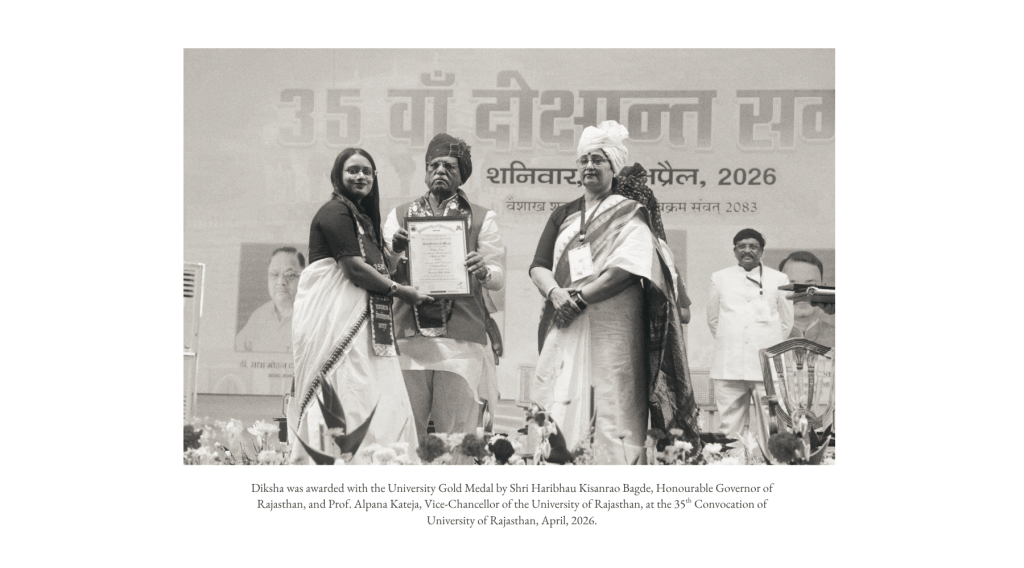
The gold medal that they so appropriately deserve is evidence that determination, hard work, sincerity, and perseverance are the ingredients of success and that turning the impossible into reality. As a department, we are proud of their achievement as it will go down in history since two of them from the same college have bagged this prestigious position. May they spread their wings wider and soar higher than ever before, reaching for the stars!
– Dr. Atiqa Kelsy
Interviewer: Can you share your journey to becoming a gold medalist in English Literature? What motivated you to pursue this field?
Ananya: I always had an affinity towards English Literature, it being my favourite subject in school as well. Although, for my bachelor’s I chose Visual Arts. I had Painting as my specialisation, hence we also studied theories of art and aesthetics. Pursuing Art History had appealed to me until I realised what I was really interested in— Stories, be it in the form of painting, words, or music! During my undergrad, I used to ask my friends from the English Department to share the cool things they were taught in class. Pursuing a Master’s in English Literature, and a career in Academia made perfect sense. Rest is history I guess, I enjoyed studying and the gold medal is just an additional reward.
Diksha: It still feels surreal to say that I’m a gold medalist in English Literature, but it was such a rewarding journey. It took dedication, consistent efforts, and a lot of motivation to get here. I focused on reading original texts, exploring additional resources, and revisiting topics to keep them fresh. Staying connected with my professors and following their advice really helped refine my approach and broaden my understanding. I chose English Literature because I’ve always been fascinated by stories and characters and the insights they provide into an author’s mind. With a background in both English and Psychology, I saw literature as the perfect way to explore the human psyche and understand people’s inner worlds.
Interviewer: What specific areas of English Literature captivated you during your studies. If you could recommend one literary text to every student of English Literature, what would it be?
Ananya: Oh I do not know where to begin! I enjoyed reading Elizabethan dramas, Romantic poetry and novels, Modernist prose and dramas. I loved that we studied Wuthering Heights, I admire that book and it was my initiation into the works of the Bronte sisters. The Modern period, if I may say so, felt a bit depressing, but it was as necessary to read. Beckket’s and Pinter’s dramas were a revelation, they were shocking and brilliantly framed. I think reading and analyzing Virginia Woolf has no end, there are so many layers to look through. I also felt grateful to study two of my favourite poets, Emily Dickinson and Robert Frost. Indian literature felt homely, works like Samskara and Final Solutions were brilliant. Now, it is quite difficult to choose a single text. From our course, I will go with John Synge’s Riders to the Sea. For no particular reason other than that I wasn’t able to get over this work for a long time, it haunted me. Personally, I would always recommend Donna Tartt’s The Secret History. It is such a brilliant text, I liked how it made me question my own sense of moralities and ethics. Needless to say, it transformed me a bit.
Diksha: That’s such a tough question, as I’m drawn to so many different genres! From Frost’s pastoral perspective to Coleridge’s enchanting, fantastical world and Milton’s grand portrayal of godly characters—each has its own unique appeal. But if I had to highlight my top two, it would be Coleridge’s intriguing exploration of the human psyche in masterpieces like Christabel, Kubla Khan, and The Rime of the Ancient Mariner, alongside Milton’s portrayal of the larger-than-life anti-hero in Paradise Lost. If I were to recommend one literary text, it would definitely be Paradise Lost (Book I)—it’s a work that captivates you and makes you fall in love with the archangel, despite his tragic fall.
Interviewer: What was the most rewarding aspect of earning a gold medal in English Literature?
Ananya: Ah I still do not know that, to be acknowledged for your hard work always feels good. During my Master’s, I wasn’t studying with the aim of being a gold medalist, yet the sound of being one felt nice. I think I may reap the material benefits of this medal in the future, but for now, it has made me feel immensely proud of the past-me. I wasn’t at my best during the final-year examinations, it was difficult to study at times. Yet, I was there for myself, being as patient as I could, offering reassurance and hugs whenever needed, showing up everyday. The gold medal is a sweet reminder of the person I was, and the person who grew through her experiences. Of course it must look very cool on your CV!
Diksha: Beyond the personal sense of pride and the joy of seeing all the hard work come to fruition, what truly made the experience rewarding was sharing that moment with my family. Their happiness and pride in me is something I’ll always cherish. It was equally fulfilling to see how proud my teachers and college were. And of course, the brilliant people I met along the way, those friendships and connections that have lasted well beyond college, are one of the most meaningful parts of this entire journey. Additionally, this achievement has added value and prestige to my professional life as an educator, opening doors to exciting new experiences and possibilities.
Interviewer: Were there any mentors or professors who significantly influenced your academic path? How did they guide you?
Ananya: I have to say that our faculty was probably more happy and excited at this achievement than I was, isn’t that sweet? All of the professors here were really kind, they fostered a healthy environment for our growth not only academically, but on a personal level. Our teachers were always a text or a call away. I could go to them if I had a silly grammar question, a serious research question, a random thought about the text we were reading, or if I required a good pep-talk, I think that pretty much sums it up. It is not an easy job, being an educator, and I quite admire how our professors navigate on this path. I am grateful they chose this profession, because they’re great at it. Our classes never felt uni-directional, we always shared a dialogue with our professors. They all know what they mean to me, and I’m glad to still share that loving relationship with them.
Diksha: Absolutely, I have to thank all my mentors as each one contributed in their own unique way to my growth as a student and as a person. Rama Ma’am, with her unwavering commitment to women’s voices and causes, offered insights that deeply enriched my perspective and made me think more critically and compassionately. Atiqa Ma’am stood out for her kindness, authenticity, and her passion for teaching. Her support often extended far beyond the classroom. Shruti Ma’am, who also taught me during my undergraduate years, brought a perfect blend of discipline and warmth. Her eye for detail and love for perfection pushed me to do better, always. And a very special mention goes to Ranjit Ma’am, my biggest motivator. It was because of her constant encouragement that I even considered appearing for the UGC NET and striving for this position. She truly believed in me, often more than I believed in myself, and I’ll always be grateful for that.
Interviewer: What do you believe is the relevance of studying English Literature in today’s world?
Ananya: The discipline of English literature, and broadly the Liberal Arts and Social Sciences are more relevant than ever in this day and age. The world is going through a tremendous shift, with humans rethinking ideas like consciousness, agency, and subjectivity.
With the AI revolution, the idea of a ‘human being’ itself is under scrutiny. Studying literature, coupled with literary theories provides one with essential skills like critical thinking, media literacy, interpersonal communication, a fantastic grasp at language, and the ability to form original and objective opinions. Literature makes you empathetic, tolerant, and observant, making it rather easier to hold respect and space for a diversity of opinions or sects. And if I speak from my heart here, what is a life without stories? I don’t want to live in a world where there are no poets, writers, artists. What kind of a world would that be? We need stories to live.
Diksha: In today’s fast moving world, where everything feels rushed and overwhelming, English Literature offers something rare—a moment to pause, reflect, and truly connect. It’s more than just reading stories; it’s an escape, a kind of therapy, and a way to expand your understanding of life without even stepping outside. In terms of relevance, it’s incredibly useful in fields like journalism and social media, where clear thinking and expression matter. And as an educator, it’s helped me grow not just in subject knowledge, but in becoming a more thoughtful, inclusive, and empathetic teacher.
Interviewer: What do you think is the recipe for earning a gold medal in MA English?
Ananya: To not study with the sole aim of earning a gold medal, rather enjoying the process of studying literature itself. You got to care about the world and its beings, you know? Literature is a lovely way to do it. Paying attention to a life lived, being curious about its written remnants— that is no less than holding love for a fellow being. Read good things, poetry and stories that move you. Rest, attending regular lectures, and reading the texts before them is always good. Feel free to explore your subject, ask questions, and discuss things with your classmates. Following a consistent answer structure is something I always try to follow, along with quoting from texts in my answers. Instead of writing a whole summary, prioritise answering what has been asked in the question. If your handwriting is as awesome (terrible & otherwordly) as mine, try to use two inks, and leave spaces in between paragraphs. Lastly, enjoy being a student while you are one, you’ll miss it soon enough.
Diksha: I completely agree with Ananya on this one— don’t do it for the medal, do it because you genuinely love it. Let your curiosity guide you. Read beyond the text, dive into background research, and don’t be afraid to step outside the syllabus now and then. Some of the most memorable moments come from discovering the lesser known stories behind the authors, like still feeling a twinge of sadness for Yeats and Maud Gonne. Enjoy the process, the learning, the conversations, the quiet discoveries. Also, when it comes to final exams, don’t rely on last minute syllabus covering. Prepare well in advance. Time management is key because you really can’t spare a minute in the exam hall. Organise your thoughts, structure your answers, and give it your best. Make sure you revise your self made notes, they’re far more reliable than refreshers, which often provide too little or miss the depth that’s actually required.
Interviewer: What advice would you give to students aspiring to excel in English Literature?
Ananya: After I finish reading a nice book, or watching a good film, I feel overwhelmed with love and wonder. Life feels surreal for a moment. I have never felt this after hours of scrolling through unnecessary bouts of information. This would be my advice, nurture yourselves by reading good literature, let yourself really feel things rather than numbing your minds. Read whatever you feel like, whenever you feel like it, but do read. You will soon realise that you’re not alone in feeling or being a certain way. A hundred years ago, somebody felt just like you do and thankfully they wrote about it. I think when we truly enjoy something, then “excellence” just follows us on its own. Dive into literature, enjoy the fact that you get to read books and get graded for it.
Diksha: My advice to students aspiring to excel in English Literature would be to complete this journey with the same motivation and passion you had when you first started. Don’t lose faith when you encounter a complex text. Seek support and guidance from your professors and peers whenever needed. Enjoy the beauty of literature, but also make sure you don’t miss out on campus activities. Sometimes, they offer experiences that take you straight to the heart of old England. Trust me, I regret not attending the annual ball!
Interviewer: What’s one misconception about studying literature that you’d like to dispel?
Ananya: I think the good old misconception of literature not being a serious subject? Studying literature involves delving into some aspects of history, psychology, sociology, cultural and scientific discourses at times. I mean, Christopher Nolan was a literature student, and I’m sure we were all left awe-struck after watching films like Interstellar or Inception. Literature is simply a beautiful collection of humanity’s innumerable memories and desires, hopes and fears, thoughts and loves. What a way to understand our weird little existence, isn’t it?
Diksha: The study of literature is often undervalued due to the misconception that it solely involves reading fiction and analyzing authors. In truth, literature opens pathways to a diverse range of impactful professions including education, journalism, creative writing, publishing, advertising, filmmaking, law, and civil services. In fact, literature is a top choice among aspirants of State and Central civil services due to its emphasis on critical thinking, cultural awareness, and strong communication skills.

